

As a supplier of CCS DC fast chargers, I'm constantly on the lookout for the latest technological advancements in our field. The demand for electric vehicles (EVs) is skyrocketing, and with it, the need for efficient and high - performing charging solutions. In this blog, I'll explore some of the new technologies being developed for CCS DC fast chargers.
High - Power Charging
One of the most significant trends in CCS DC fast charging is the push towards higher power levels. Traditional DC fast chargers typically operate in the range of 50 - 150 kW. However, new technologies are enabling chargers to reach much higher power outputs. For example, some companies are developing chargers with power ratings of up to 350 kW or even higher.
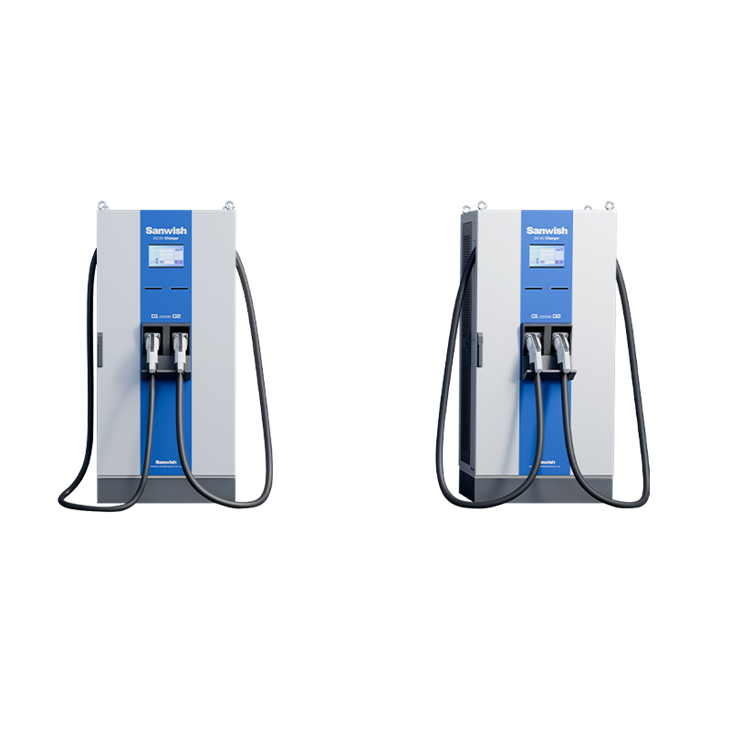

Higher power charging means significantly reduced charging times. An EV that might take an hour to charge at a 150 kW charger could potentially be charged in half the time or less at a 350 kW charger. This is a game - changer for EV owners, especially those on long - distance trips. It addresses one of the major concerns of EV adoption: range anxiety. With faster charging, drivers can get back on the road more quickly, making EVs a more practical option for everyday use and long - haul travel.
Liquid - Cooling Technology
As chargers operate at higher power levels, they generate a significant amount of heat. Excessive heat can not only reduce the efficiency of the charger but also damage its components over time. Liquid - cooling technology is emerging as a solution to this problem.
In a liquid - cooled CCS DC fast charger, a coolant (usually a mixture of water and glycol) circulates through the charger's components, absorbing heat and transferring it away. This helps to maintain a stable operating temperature, ensuring that the charger can operate at peak efficiency for longer periods. Liquid - cooled chargers are also more reliable and have a longer lifespan compared to their air - cooled counterparts.
Moreover, liquid - cooling technology allows for more compact charger designs. Since the heat can be dissipated more effectively, the charger doesn't need large heat sinks or fans, which can take up a lot of space. This is beneficial for installation in various locations, such as parking lots and gas stations, where space may be limited.
Smart Charging and Grid Integration
New technologies are also enabling CCS DC fast chargers to be more intelligent and better integrated with the power grid. Smart charging systems can communicate with the EV, the charger, and the power grid to optimize the charging process.
For example, a smart charger can adjust the charging rate based on the state of charge of the EV's battery, the available power from the grid, and the time - of - use electricity rates. If the grid is experiencing high demand, the charger can reduce its power consumption to avoid overloading the grid. On the other hand, if there is excess power available, such as during off - peak hours, the charger can charge the EV at a faster rate.
Grid integration also allows for vehicle - to - grid (V2G) technology. In a V2G system, an EV can not only draw power from the grid but also feed power back into it when needed. This can help to balance the grid, especially with the increasing penetration of renewable energy sources like solar and wind, which are intermittent in nature. An EV connected to a smart CCS DC fast charger can act as a mobile energy storage unit, providing power to the grid during peak demand periods.
Wireless Charging for CCS DC
Wireless charging technology is another area of development for CCS DC fast chargers. Although wireless charging for EVs is still in its early stages, significant progress has been made.
Wireless charging eliminates the need for physical cables, making the charging process more convenient for EV owners. With a wireless CCS DC fast charger, an EV can simply park over a charging pad installed on the ground, and the charging process will start automatically. This technology also has the potential to be integrated into public transportation systems, such as buses and taxis, where vehicles can be charged while waiting at stops.
However, there are still some challenges to overcome with wireless charging. The efficiency of wireless power transfer is currently lower than that of wired charging, and there are concerns about electromagnetic interference. But researchers are working on improving the technology, and it's likely that we'll see more widespread adoption of wireless CCS DC fast chargers in the future.
Bidirectional Charging
Bidirectional charging is an exciting development in the world of CCS DC fast chargers. In addition to V2G, bidirectional charging allows for vehicle - to - home (V2H) and vehicle - to - vehicle (V2V) charging.
With V2H, an EV can power a home during a power outage or peak electricity demand periods. The EV's battery can act as a backup power source, providing essential electricity for lights, appliances, and other devices. This not only provides added convenience for homeowners but also helps to reduce the overall energy consumption from the grid.
V2V charging, on the other hand, enables one EV to charge another. This can be useful in situations where an EV is running low on battery and there is no nearby charging station. A fully - charged EV can share its energy with the depleted one, extending the range of the latter.
The Future of CCS DC Fast Chargers
The development of these new technologies is shaping the future of CCS DC fast chargers. As an industry, we're moving towards a more efficient, intelligent, and sustainable charging ecosystem.
These advancements will not only benefit EV owners but also contribute to the overall growth of the electric vehicle market. Faster charging times, better grid integration, and more convenient charging options will make EVs more appealing to a wider range of consumers.
If you're interested in learning more about our CCS DC fast chargers or are looking to purchase high - quality charging solutions, we'd love to have a conversation with you. Our chargers are designed to incorporate the latest technologies, ensuring optimal performance and reliability. Whether you need a DC Charger for Home, a DC Charger Home, or a DC Level 3 Charger, we have the products to meet your needs. Contact us today to start a procurement discussion and be a part of the electric vehicle revolution.
References
- Brown, T. (2020). "Advances in Electric Vehicle Charging Technology". Journal of Energy Research.
- Green, S. (2021). "Liquid - Cooling Systems for High - Power EV Chargers". International Journal of Thermal Management.
- White, R. (2022). "Smart Charging and Grid Integration in EV Infrastructure". Energy Policy Review.